
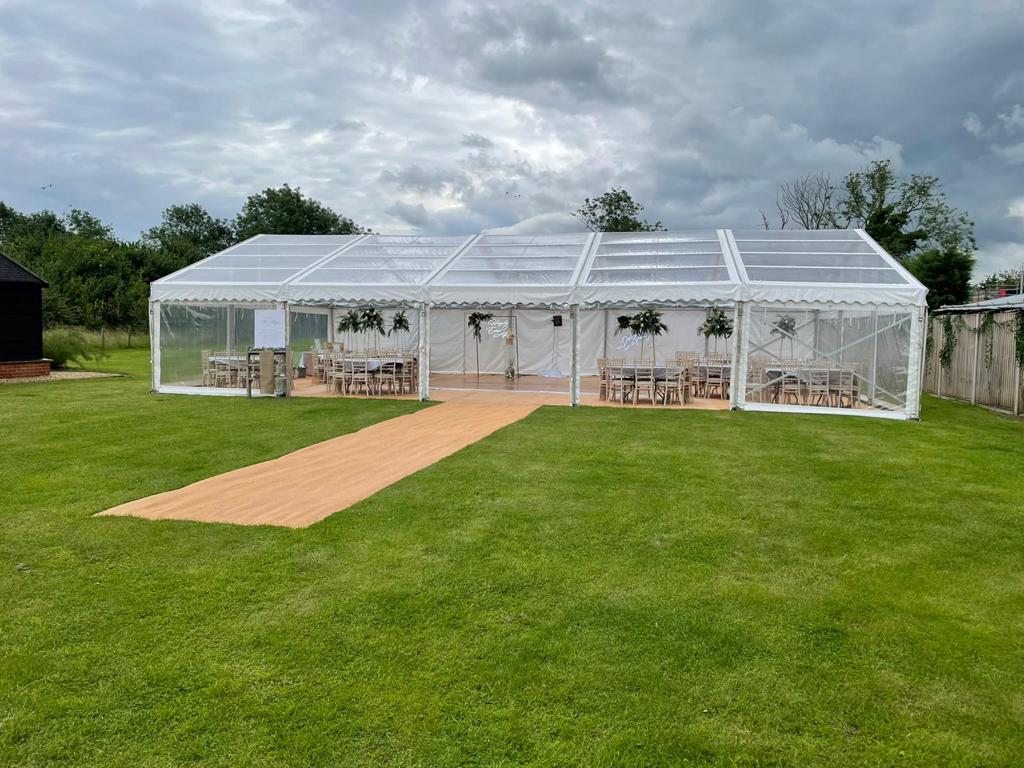
A field, lawn or private garden can be a brilliant setting for an event. You have freedom over the layout, can create spaces that would be impossible inside a conventional venue, and often have a much more interesting backdrop to work with.
But grass changes the practical side of event planning.
Instead of starting with a building where the floor, power, lighting and facilities already exist, you are effectively creating your venue from the ground up. Sometimes quite literally.
From what happens after heavy rain to how guests find the toilets after dark, here are some of the details worth considering when planning an event on grass.
Start With What Is Under Your Feet
A lawn that looks perfectly level from a distance may feel very different once you start putting tables, chairs and event equipment on it.
Small slopes and uneven areas can affect where furniture can sensibly be positioned. Ground conditions can also change considerably after prolonged dry weather or several days of rain.
This is particularly important inside a marquee. Guests will be walking, dining and potentially dancing in the same space for several hours, so the surface needs to work as part of the venue rather than simply being hidden underneath it.
For marquee events, a proper subfloor can provide a more stable surface above the ground. Red Woodpecker’s marquee flooring hire options include wooden subflooring, damp-proof membrane and single-use carpet.
It is worth deciding on flooring early because it influences other decisions, including furniture layouts, entrances, heating and how guests move through the marquee.
Think About the Route, Not Just the Destination
One of the easiest mistakes with outdoor events is concentrating on the main marquee or event area and forgetting how everybody gets there.
Follow the journey a guest will actually make.
Where will they arrive? How will they reach the marquee? Where are the toilets? Is there an outside bar or seating area? What route will they take between these spaces?
Now imagine making the same journey after several hours of rain, or at 10pm when the surrounding field is dark.
Exterior walkways can help create more defined routes across grass, particularly between frequently used areas. Red Woodpecker Event Hire has exterior coconut matting walkways within its event equipment range for this purpose.
The same thinking applies to suppliers. Caterers, entertainment, toilet facilities and other equipment may all need access before guests arrive. A beautiful position in the far corner of a field is less appealing if getting everything there proves difficult.
Plan for Darkness Before It Gets Dark
A summer event may begin in full daylight, which can make outdoor lighting feel like a decorative decision rather than a practical one.
Then the sun goes down.
Suddenly the route between the marquee and toilets matters. So does the entrance, an outside seating area and any path guests regularly use.
This is why outdoor lighting needs to do two jobs. It can create atmosphere, but it can also help define the spaces people are expected to use.
Exterior festoon lighting can be particularly effective for outdoor events because it helps visually connect separate areas while adding atmosphere. Flood lighting may also be appropriate where more functional illumination is required.
Rather than simply asking where lighting would look attractive, consider where people will actually need to see.
Work Out Where the Power Is Coming From
A conventional venue usually has an established electrical supply. A field may not.
Even when a nearby building has power, that does not automatically mean the available supply is suitable for everything planned for the event.
Think about the complete setup. Lighting, refrigeration, entertainment, catering equipment and other event infrastructure can all introduce electrical requirements.
Where an appropriate mains supply is unavailable, an event generator may form part of the infrastructure.
This is an area where planning should be done professionally. Electrical requirements need to be assessed as a complete system rather than guessing the generator size or adding individual pieces of equipment as the event develops.
Remember That a Warm Afternoon Can Become a Cool Evening
Outdoor events can change character surprisingly quickly as daylight disappears.
Guests who were comfortable outside during the afternoon may naturally move towards covered areas later in the evening. If you are using a marquee, like one supplied by our friends at County Marquees East Anglia, heating may therefore be worth considering even when the event is not taking place in winter.
The time of year, event duration, marquee construction, entrances, flooring and expected conditions can all affect heating requirements.
Our complete guide to marquee heaters explains this in more detail, including why heating should be considered alongside flooring and power rather than as a last-minute response to the weather forecast.
Give Toilets More Thought Than “Somewhere Over There”
Toilets are not the glamorous part of planning an outdoor event, but their position can have a surprisingly large effect on how well the site works.
They need to be accessible without dominating the main event space. Guests also need to be able to find and reach them comfortably, particularly after dark.
The route matters as much as the position.
Red Woodpecker’s luxury mobile toilets are self-contained and do not require mains water or drainage, although they do require access to electricity. That electrical requirement needs to be included when planning the wider power provision for the site.
This is a good example of why individual pieces of event equipment should not be considered in isolation.
Use Furniture to Create Structure in an Open Space
One of the advantages of a field or large garden is space. It can also be one of the challenges.
Without the walls and rooms of a traditional venue, different parts of an outdoor event can easily feel disconnected.
Furniture can help give those spaces a purpose. Dining tables establish the main reception area. An outdoor seating arrangement can create somewhere quieter to gather. A mobile bar can become a natural social focal point. Bistro furniture can give guests somewhere to sit without creating another formal seating area.
The important consideration is how these areas relate to one another.
Avoid looking at the site purely as a plan of where things will fit. Think about where people will naturally want to go and whether the layout encourages sensible movement between dining, drinks, entertainment, toilets and outdoor spaces.
Have a Wet-Weather Version of the Same Event
A wet-weather plan should not simply be “everyone goes inside the marquee”.
Think about what rain changes.
Will the main walking routes still work? Does outside furniture need to move? Will guests queue or congregate around the entrance? Does an outdoor bar suddenly become impractical? Are frequently used routes likely to become muddy?
Some outdoor elements can work perfectly well in changeable weather, but the layout should allow the event to adapt without having to reinvent it on the day.
It can be useful to mentally run through the event twice: once on a dry, warm afternoon and again after several hours of rain.
If the second version creates obvious problems, those are the details to solve before the event.
Treat the Field Like a Venue
The best outdoor events do not feel like equipment has simply been placed in a field. They feel like the field has been turned into a venue.
That means thinking beyond the marquee itself.
Ground conditions, flooring, power, lighting, heating, toilets, furniture, access and guest routes all interact. Making those decisions together can create an event that works comfortably from the first supplier arriving on site to the last guests leaving after dark.
If you are planning a marquee, wedding, party or other outdoor event, our guide to marquee accessories is a useful next step for considering the equipment that can turn a temporary outdoor space into a practical event setting.